
 By Chloë Lawrence
Lisa Page Literary Education Fellow
I drove to Dunbar High School after a snowstorm. Thick slabs of ice, like glaciers, hugged the roads of DC, turning two-way streets into one-way and causing road closures across the city. Cautiously optimistic, I chugged my way from Northwest to Northeast, unaware how much the author visit I was heading to would reignite my soul after two weeks of below-freezing temperatures.
I was lucky enough to get a spot in front of the school. I wedged my car between two dirty snow mounds and ran up a flight of stairs that led to the front doors of Dunbar, a historically Black high school. The first of its kind in America, Dunbar is nestled in the Truxton Circle Community.
The school opens onto a vast common space, where students gather to chat and share a bite with friends before heading to class. I headed to the office and waited for Kim Johnson, the author for that day’s visit. Dr. Warren, a social studies teacher, escorted us to her classroom. We walked into a warm, dimly lit room with walls covered in social justice posters and t-shirts reading “Know Your Rights.” Fifteen students sat quietly, waiting for the visit to begin.
Kim Johnson, author of This is My America, Invisible Son, and Color of a Lie, started the visit with a social justice exercise, asking questions like “Would you rather call out injustice even if it could put you in danger or stay silent?” Her questions were thought-provoking, prompting discussion about the challenges of negotiating safety amid racial injustice.
At one point after the exercise, Kim turned to the class and said, “I grew up in Oregon, where I was the only Black student most years. I had to weigh whether I wanted to stay silent or speak out because there was no support or rest for someone like me.” There was a poignant silence in the room. Kim elaborated, explaining that growing up, she didn’t have representation; most of her teachers, mentors, and friends were white.
Kim told the students about one of her books, This is My America, a novel about a seventeen-year-old girl, Tracy Beaumont, who is fighting to get her innocent father off of death row while her brother is wrongfully accused of murder. Tracy, determined to get justice for her brother and father, has been writing letters to an organization called “Innocent X,” a fictional non-profit inspired by the real-life “Innocence Project,” which is dedicated to exonerating wrongfully accused individuals.
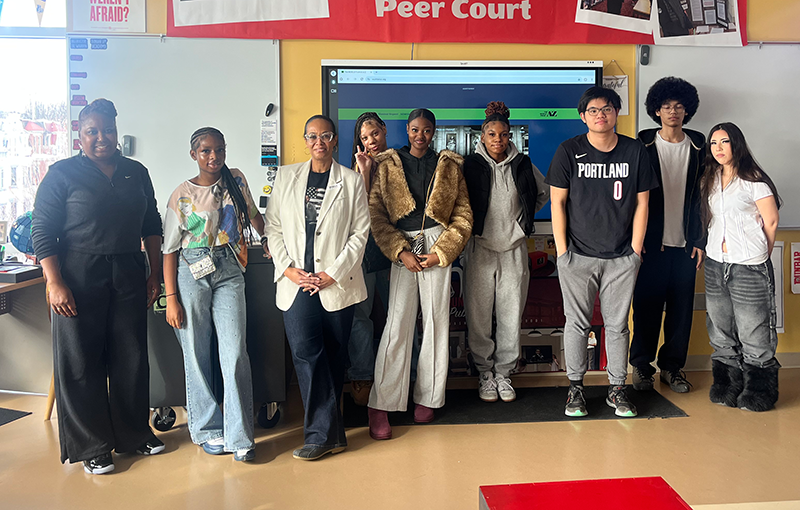
“What does fighting for justice look like?” Kim asked the students, after telling them about Tracy’s story.
“Learning,” someone said. “Learning about the history of injustice could help us fight for justice.”
The student’s remark prompted Kim to ask, “Why would someone not want students to learn about black history or other social justice issues?”
“White privilege,” someone said. Everyone leaned in to listen. “Racism isn’t over; it’s still everywhere. When people highlight that, people don’t want to face the reality,” they finished.
There was a ripple of nodding heads throughout the classroom.
Kim clicked forward in her presentation to a slide about a banned book… her banned book. The slide was a fitting visual representation of the student’s point. Kim explained that a predominantly white school in Bucks County, PA, had banned This is My America. Kim circled back to white privilege, which she called the foundation of that book ban. “People don’t want to examine the past and look at systems or structures where they benefited from white privilege,” she said.
The most inspiring part of the visit was when Kim showed a photo of a group of students wearing Black Lives Matter shirts and holding copies of This is My America. Kim explained that the photo was of a group of students from the Bucks County School District actively challenging the ban on Kim’s book and other books by Black authors. It was a welcome reminder that change starts in small spaces and that it is so often younger people who work to make the world a better place.
The visit wrapped up with Kim asking the students what one big change they’d like to see in the world was. “I’d like to see those in power held accountable,” someone said.
During trying times, times that often feel hopeless, times that feel like no one is holding the powerful accountable, I know that it is the students around me who hold onto hope for a better future.
Before leaving, they asked Kim how they could be advocates for change, and in asking, those students made one small change.